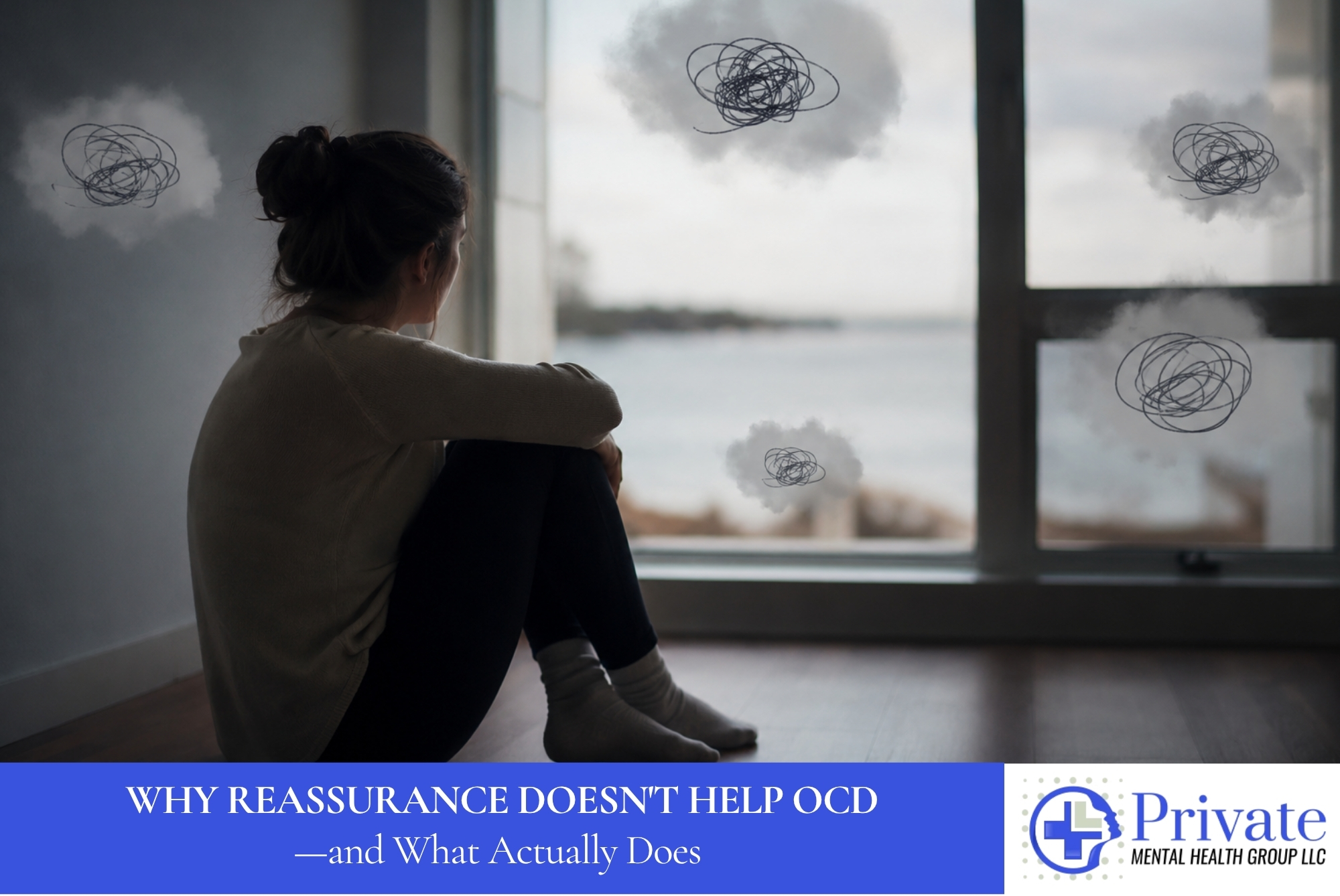
When obsessive-compulsive disorder (OCD) creates intense uncertainty, fear, or doubt, reassurance can feel like exactly what is needed. A person may ask a loved one, therapist, friend, or even the internet to confirm that everything is okay: “Are you sure I didn’t do something wrong?” “What if I’m actually a bad person?” “Can you promise I’m not sick?” “Do you think this thought means something about me?”
Receiving an answer may bring immediate relief. The problem is that the relief usually does not last.
For many people with OCD, repeated reassurance can become part of the obsessive-compulsive cycle. Instead of teaching the brain that uncertainty and anxiety can be tolerated, reassurance may teach it that distress must be resolved before a person can move forward. As a result, the next intrusive thought or doubt can generate another urgent need for certainty.
Understanding this distinction is important for people living with OCD and for the family members, partners, and friends who want to support them. Effective OCD treatment generally does not focus on proving that a feared outcome will never happen. Instead, evidence-based approaches help people change how they respond to intrusive thoughts, uncertainty, anxiety, and compulsive urges.
Understanding the OCD Cycle
What Is Obsessive-Compulsive Disorder?
Obsessive-compulsive disorder is a mental health condition characterized by obsessions, compulsions, or both. Obsessions are recurrent, unwanted thoughts, images, sensations, or urges that can cause significant distress. Compulsions are repetitive behaviors or mental acts that a person feels driven to perform, often in an attempt to reduce distress or prevent a feared event.
OCD can involve many themes. Common examples include contamination, harm, morality, religion, relationships, sexuality, health, responsibility, mistakes, symmetry, and the fear of losing control.
The specific subject of an obsession can vary considerably. A central problem, however, is often the way the person becomes caught in a cycle of doubt, distress, and attempts to obtain certainty.
How Obsessions and Compulsions Reinforce Each Other
A simplified OCD cycle can look like this:
An intrusive thought, image, urge, sensation, or doubt appears. The person interprets it as significant or threatening. Anxiety, guilt, disgust, fear, or uncertainty increases. The person performs a compulsion to reduce the discomfort. Temporary relief follows.
Because the compulsion appears to have relieved the distress, the brain can learn that the compulsion was necessary. The next time a similar trigger occurs, the urge to perform the behavior may become even stronger.
Compulsions are not always visible. Checking locks or repeatedly washing hands may be recognizable compulsions, but OCD can also involve mental reviewing, analyzing memories, silently repeating phrases, researching, confessing, comparing feelings, testing reactions, and repeatedly seeking reassurance.
Why Reassurance Can Become an OCD Compulsion
Reassurance Provides Relief Without Resolving the Underlying Pattern
Imagine that someone with OCD fears they may have accidentally offended another person. They ask a friend, “Do you think what I said was offensive?”
The friend says, “No. You didn’t do anything wrong.”
The person feels better—but only temporarily.
Soon, OCD may introduce another question: “What if my friend is only saying that to make me feel better?” The person may explain the situation again, ask someone else, search online, replay the conversation mentally, or look for subtle signs that the other person was upset.
The original question may change, but the underlying demand remains: obtain enough certainty to make the uncomfortable feeling disappear.
This is one reason reassurance can become problematic in OCD. It can provide short-term relief while strengthening the belief that uncertainty is dangerous and must be eliminated.
OCD Often Demands a Level of Certainty That Life Cannot Provide
Everyday life contains uncertainty. People cannot obtain absolute guarantees about their health, relationships, memories, morality, future actions, or how other people perceive them.
OCD can make ordinary uncertainty feel unacceptable.
A person may intellectually recognize that a feared scenario is improbable while still feeling compelled to establish that it is impossible. Reassurance often tries to satisfy that demand. Unfortunately, another “what if?” can almost always follow.
Treatment therefore often involves developing a different relationship with uncertainty rather than finding increasingly convincing arguments against every obsession.
Reassurance Seeking Can Take Many Forms
Direct Reassurance Seeking
Direct reassurance seeking may include repeatedly asking questions such as:
“Am I going to be okay?”
“Are you sure I didn’t hurt anyone?”
“Does this mean I’m a bad person?”
“Are you certain this symptom isn’t dangerous?”
“Do you still love me?”
“Would you tell me if I had done something wrong?”
A single question is not automatically a compulsion. Context, repetition, motivation, and the function of the behavior matter. Reassurance becomes especially relevant to OCD when it is repeatedly used to neutralize distress or achieve certainty.
Indirect Reassurance Seeking
Reassurance can also be less obvious. A person might describe an event repeatedly while waiting for someone to say that they did nothing wrong. They may ask hypothetical questions, compare their behavior with other people’s behavior, or repeatedly request another person’s opinion.
Someone might also phrase the same underlying fear in several different ways, hoping that one answer will finally feel convincing enough.
Digital Reassurance Seeking
Search engines, online forums, social media, symptom checkers, and other digital resources can become part of the reassurance cycle.
A person concerned about contamination, for example, may repeatedly research how long a microorganism can survive on a surface. Someone experiencing health-related obsessions may repeatedly research symptoms. Someone with moral or relationship obsessions may search for articles that confirm what a thought, feeling, or behavior “really means.”
Educational information can be useful. The key question is what function the searching serves. If research is repeatedly being used to reduce obsessional anxiety or establish complete certainty, it may be functioning as a compulsion.
Why Reassurance Feels So Convincing in the Moment
Negative Reinforcement Can Strengthen the Cycle
One useful behavioral concept for understanding compulsions is negative reinforcement.
In psychology, negative reinforcement does not mean punishment. It refers to a behavior becoming more likely because it removes or reduces something unpleasant.
An obsession produces distress. Reassurance reduces that distress. The brain therefore learns that asking for reassurance works.
This learning can make reassurance seeking more likely when the next intrusive thought appears. Over time, a person may become increasingly dependent on external confirmation to manage uncertainty.
Temporary Relief Is Different From Long-Term Recovery
The distinction between immediate relief and long-term improvement is central to OCD treatment.
A behavior can feel helpful in the moment while maintaining the broader problem. Compulsions are powerful partly because they often do reduce anxiety temporarily.
Effective treatment seeks to help a person discover that anxiety, doubt, and uncertainty can change without compulsive attempts to eliminate them.
What Actually Helps OCD?
Exposure and Response Prevention (ERP)
Exposure and Response Prevention, commonly called ERP, is a form of cognitive behavioral therapy used in the treatment of OCD.
Exposure involves intentionally and systematically encountering situations, thoughts, images, sensations, or uncertainty that trigger obsessive fears. Response prevention involves resisting or reducing the compulsions that would ordinarily be used to neutralize the resulting distress.
For someone whose compulsion is reassurance seeking, response prevention may include practicing not asking another person to confirm that everything is okay.
The purpose is not to prove that the feared outcome is impossible. Instead, ERP can help a person learn that they can experience uncertainty and distress without automatically responding with a compulsion.
ERP should be individualized. A qualified mental health professional can help determine appropriate exercises, pacing, goals, and clinical considerations.
Learning to Tolerate Uncertainty
OCD frequently revolves around questions that cannot be answered with absolute certainty.
Treatment may therefore help a person practice responses such as allowing uncertainty to exist rather than trying to resolve it immediately.
This does not mean agreeing that a feared outcome will occur. It means reducing the struggle to obtain an impossible guarantee that it cannot occur.
Over time, a person may become more capable of thinking, in effect, “I don’t know for certain, and I can continue with my day anyway.”
Allowing Intrusive Thoughts Without Trying to Neutralize Them
Intrusive thoughts occur across the general population. Having an unwanted thought is not the same as wanting it, endorsing it, or acting on it.
With OCD, the effort to determine exactly what a thought means can become part of the problem.
Treatment may help individuals notice an intrusive thought without debating it, disproving it, confessing it, analyzing it, checking their emotional reaction, or seeking reassurance about its significance.
The objective is not necessarily to make intrusive thoughts disappear. It is to reduce the compulsive response to them.
Reducing Mental Compulsions
Avoiding reassurance alone may not be sufficient if external reassurance is simply replaced by internal reassurance.
Mental compulsions can include reviewing past events, reconstructing memories, analyzing intentions, repeating reassuring statements, testing feelings, or trying to “figure out” an obsession.
Identifying these less-visible behaviors can be an important component of OCD treatment.
How Family Members and Partners Can Help Without Feeding OCD
Support the Person Rather Than the Compulsion
When someone you care about is distressed, refusing reassurance can initially feel cold or unhelpful. The alternative, however, does not have to be dismissive.
A supportive response can acknowledge the person’s distress without resolving the obsession for them.
For example, instead of repeatedly guaranteeing that a feared event will not happen, a loved one may reinforce the person’s ability to use treatment strategies and tolerate uncertainty.
This distinction can be powerful: emotional support remains available even when participation in the compulsion decreases.
Establish a Plan With the Treating Clinician
Family accommodation can occur when relatives or partners participate in rituals, alter routines around OCD, answer repeated reassurance questions, or help the person avoid triggers.
Reducing accommodation may be helpful, but abrupt changes can create confusion or conflict. When possible, families can work with an OCD-informed clinician to determine which behaviors are maintaining compulsions and develop a consistent approach to responding.
Avoid Turning “No Reassurance” Into a Rigid Rule
OCD treatment is individualized. Not every request for information is compulsive, and ordinary emotional support should not automatically be labeled reassurance.
The relevant question is often whether the interaction is helping someone obtain reasonable information or whether it is being repeatedly used to neutralize obsessional distress.
A clinician familiar with OCD can help distinguish between healthy support, appropriate information seeking, and compulsive reassurance.
The Difference Between Reassurance and Helpful Support
Reassurance Attempts to Settle the Obsession
Compulsive reassurance often tries to answer the obsession on its own terms:
“You definitely aren’t contaminated.”
“You absolutely didn’t offend anyone.”
“That thought definitely means nothing.”
“You certainly won’t make that mistake.”
Although these statements may reduce anxiety briefly, OCD can quickly challenge them.
Helpful Support Builds the Person’s Capacity to Respond Differently
Supportive responses can focus on the process rather than the feared scenario.
A loved one might acknowledge that the person is experiencing significant anxiety, encourage them to follow strategies developed with their clinician, or remind them that they do not have to solve every uncertain thought immediately.
This approach avoids debating the content of the obsession while still providing compassion and connection.
Why Logic Alone Often Doesn’t Resolve OCD
OCD Can Turn Rational Analysis Into Another Ritual
It is tempting to respond to an obsession by assembling evidence.
For ordinary worries, evaluating evidence can sometimes be useful. With OCD, however, analysis can become repetitive and compulsive.
A person may find one convincing argument and then immediately discover an exception. They answer the exception and another appears. Hours can be spent trying to reach a level of certainty that never feels complete.
The issue is therefore not necessarily a lack of intelligence, insight, or logical ability. The problem can be the compulsive demand to keep analyzing until uncertainty disappears.
Recovery Is About Changing the Response to Doubt
OCD recovery does not necessarily mean never experiencing another intrusive thought.
A more useful goal may be developing the ability to encounter intrusive thoughts, uncertainty, or uncomfortable emotions without allowing them to dictate behavior.
As compulsive responses decrease, obsessions may become less disruptive and less influential over daily life.
When to Consider Professional OCD Treatment
OCD Can Significantly Affect Daily Functioning
Professional evaluation may be appropriate when intrusive thoughts and repetitive behaviors consume substantial time, cause significant distress, interfere with relationships, disrupt school or employment, contribute to avoidance, or make ordinary responsibilities difficult.
Because OCD can present in many different ways, some people live with symptoms for years before recognizing the pattern.
Specialized Knowledge Matters
People seeking care for possible OCD may benefit from asking prospective clinicians about their experience assessing and treating OCD, including their familiarity with ERP and other evidence-based approaches.
Treatment should account for each person’s symptoms, history, circumstances, co-occurring concerns, and clinical needs.
Private Mental Health Group LLC provides mental health services through in-person offices and telehealth availability in designated locations. Individuals interested in care can contact the practice to discuss available services and whether they may be appropriate for their needs.
Frequently Asked Questions About OCD and Reassurance
Why is reassurance bad for OCD?
Reassurance is not inherently “bad.” The concern is repeated reassurance that functions as a compulsion. When reassurance repeatedly removes obsessional anxiety, it can reinforce the cycle in which uncertainty triggers distress and distress triggers reassurance seeking. OCD treatment may therefore involve gradually reducing compulsive reassurance while developing healthier responses to uncertainty.
Is asking for reassurance always a compulsion?
No. People naturally seek advice, information, comfort, and feedback. Reassurance may be more likely to function as an OCD compulsion when the same or similar question is asked repeatedly, the answer provides only temporary relief, or the primary goal is to eliminate obsessional uncertainty.
Why doesn’t reassurance make OCD anxiety go away permanently?
Reassurance may answer one version of an obsessive doubt, but OCD can generate another. A person may initially ask whether something happened and then wonder whether the person reassuring them has enough information, remembers correctly, or is simply trying to make them feel better. The cycle continues because the underlying intolerance of uncertainty has not been addressed.
What should I say instead of reassuring someone with OCD?
There is no universal script. A helpful response can acknowledge the person’s distress while avoiding repeated attempts to prove the obsession wrong. When the person is receiving OCD treatment, family members can follow the response plan developed with their clinician.
Does refusing reassurance mean ignoring someone who is anxious?
No. Emotional support and compulsive reassurance are different. A loved one can remain present, compassionate, and supportive without repeatedly answering the obsession’s demand for certainty.
Can Googling symptoms or fears be an OCD compulsion?
Yes, in some circumstances. Repeated online searching can function as reassurance seeking when it is primarily intended to eliminate obsessional uncertainty. Occasional research for legitimate information is different. Frequency, urgency, repetition, and the purpose of the behavior are important considerations.
Can I reassure myself instead of asking other people?
Self-reassurance can also become compulsive. Repeatedly telling yourself that everything is definitely fine, mentally reviewing evidence, or trying to prove that a feared outcome cannot happen may perform the same function as external reassurance.
What is ERP for OCD?
Exposure and Response Prevention is a therapeutic approach in which a person practices encountering obsession-related triggers while reducing or resisting compulsive responses. The process is typically individualized according to the person’s symptoms and treatment needs.
Does ERP mean deliberately putting yourself in danger?
ERP is not intended to require genuinely dangerous behavior. Therapeutic exposures are designed around clinically appropriate encounters with feared situations, thoughts, sensations, or uncertainty rather than unnecessary real-world hazards. A qualified clinician can help distinguish appropriate exposure work from actual safety concerns.
Does ERP make anxiety worse?
Exposure exercises can produce temporary discomfort because they involve facing triggers without relying on familiar compulsions. The therapeutic objective is to develop a different response to distress and uncertainty over time. The intensity and progression of ERP should be individualized.
Can OCD be treated through telehealth?
OCD assessment and treatment can sometimes be delivered through telehealth when clinically appropriate and when the clinician is authorized to provide care in the patient’s location. Availability depends on factors including location, provider licensure, clinical needs, and the services offered by the practice.
Can family members participate in OCD treatment?
Family involvement may be beneficial in some cases, particularly when relatives have become involved in reassurance, avoidance, or rituals. A clinician may help family members recognize accommodation and develop more supportive ways of responding.
How do I know whether I have OCD or normal anxiety?
Occasional intrusive thoughts, doubts, and requests for reassurance do not automatically indicate OCD. Diagnosis requires a professional assessment that considers the nature of obsessions or compulsions, distress, time involved, functional impairment, and other possible explanations for symptoms.
What should I do when I feel an urgent need for reassurance?
If reassurance seeking is part of an established OCD pattern, an OCD-informed therapist may help you develop strategies for responding to the urge without automatically performing the compulsion. Because treatment plans differ, people currently receiving care should follow recommendations developed with their clinician.
Can OCD focus on relationships, morality, health, or harming someone?
OCD can involve many themes, including relationships, morality or scrupulosity, health, contamination, responsibility, sexuality, religion, and fears about causing harm. The presence of a particular intrusive thought does not by itself establish an OCD diagnosis; a qualified professional can evaluate the broader symptom pattern.
When should someone seek professional help for OCD symptoms?
Consider speaking with a qualified mental health professional when obsessions or compulsions are causing significant distress, consuming substantial amounts of time, interfering with work or school, affecting relationships, creating extensive avoidance, or reducing quality of life.
Moving Beyond the Reassurance Cycle
Reassurance is appealing because it promises something OCD desperately wants: certainty.
Yet repeatedly pursuing certainty can keep a person trapped in the very cycle they are trying to escape. The more important therapeutic skill may be learning that every intrusive thought does not require an answer, every uncomfortable feeling does not require immediate relief, and every uncertainty does not have to be resolved before life can continue.
Evidence-based OCD treatment, including approaches such as Exposure and Response Prevention, can help people practice responding differently to obsessions and compulsions. Rather than repeatedly proving that a feared possibility is impossible, treatment can build greater flexibility in the presence of uncertainty.
For people who recognize a pattern of intrusive thoughts, reassurance seeking, checking, avoidance, mental reviewing, or other compulsive behaviors, a professional mental health evaluation can help clarify what is happening and identify appropriate treatment options.
Contact Information
Private Mental Health Group LLC
Website: sanityteam.com
Phone: (954) 794-9000
In-Person Offices
Staten Island, New York
188 Hylan Blvd.
Staten Island, NY 10305
New York City, New York
80 Beekman Street, Unit K
New York, NY 10038
Fort Lauderdale, Florida
12 SE 7th Street, Suite 705
Fort Lauderdale, FL 33301
Telehealth Services
Telehealth services are available in:
Delaware
Pennsylvania
Georgia
Tinton Falls
Prospective patients may contact Private Mental Health Group LLC to confirm current service availability, clinician availability, licensing coverage, and whether telehealth or in-person care is appropriate for their needs.